



The State of
Printing 2026

Your data-driven guide to modernizing print, brought to you by Y Soft: Cloud printing research based on actual device telemetry.

Get the full report
State of Printing Report Y Soft

The Year of Cloud Print

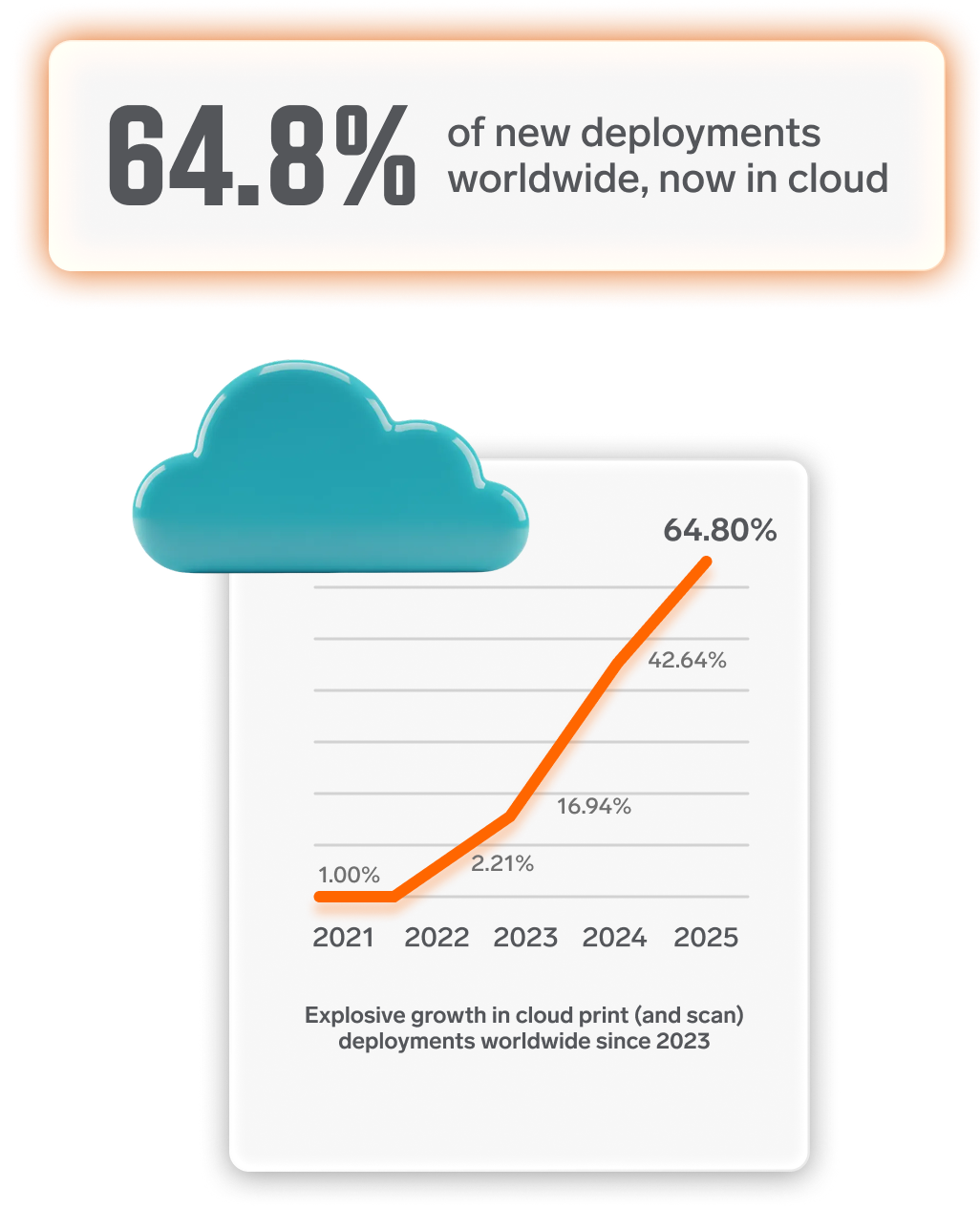
In 2025, the market reached a tipping point in cloud adoption. After years of steady growth, from single-digit to double-digit percentages between 2021 and 2024, cloud deployments now overtake on-premises globally.

This acceleration reflects more than market momentum. As customers has made it clear that print isn't a priority, Y Soft has shifted its focus toward a cloud-first approach aimed at eliminating day-to-day print management. By responding to how customers actually want to engage with print, our No Print Management shift helped unlock faster adoption as customers moved to cloud on their own terms.

Today, 64.8% of new deployments worldwide are in cloud.

Customer Drivers Signal No Print Management

76% of IT teams either have, or plan to, move print to the cloud in the next three years

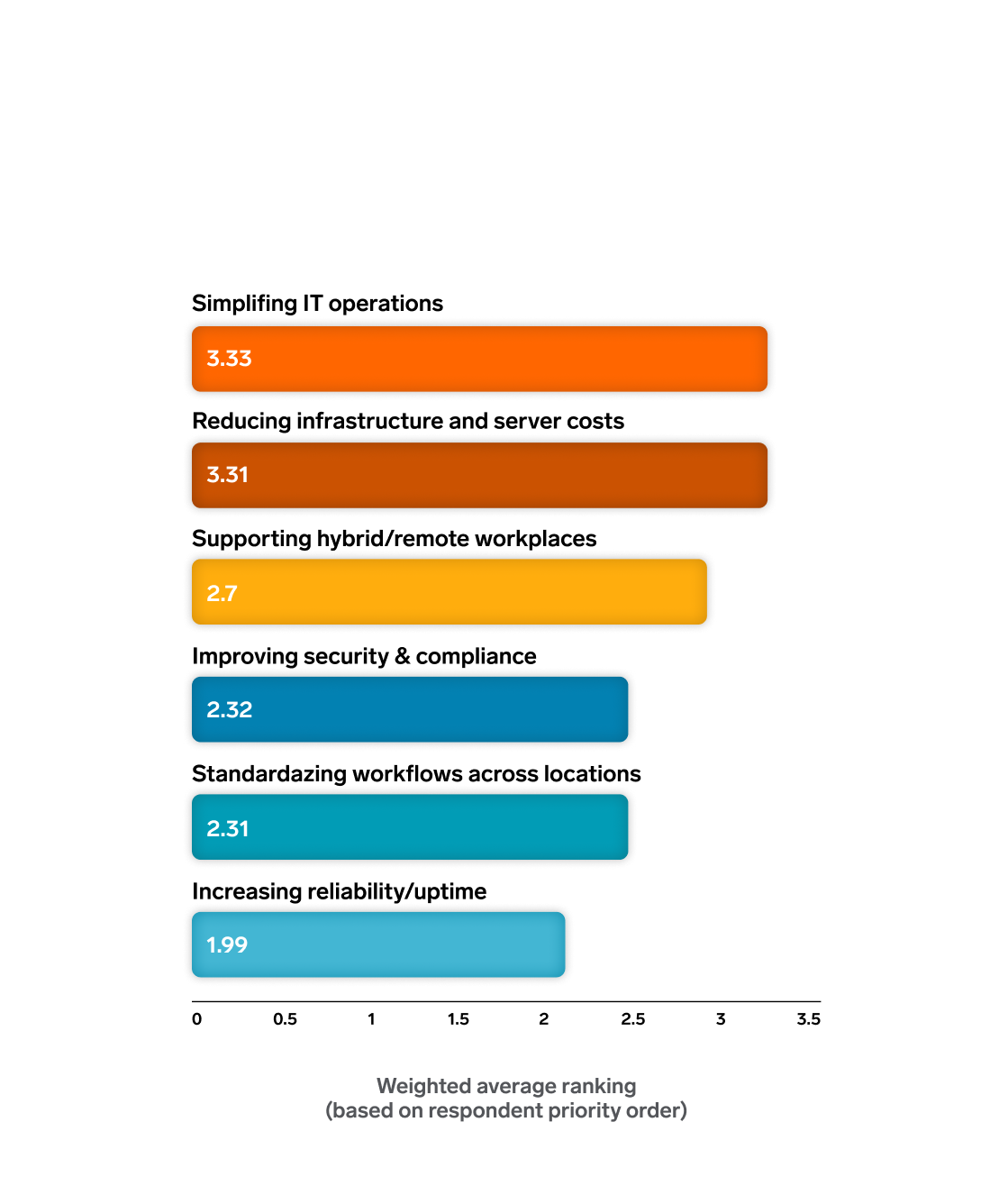
Customers consistently tell us they want print off their desks. It isn’t a priority, but it still needs to work. Moving print to the cloud reduces the cost and effort of running servers and infrastructure, while removing day-to-day management from IT teams without sacrificing reliability or control. This shift is reflected across SAFEQ Cloud environments, where organizations are moving away from on-prem print servers and managing print as a background service— reliably, securely, and largely hands-off for IT teams.

Cloud Gains Ground Across Regions

Europe

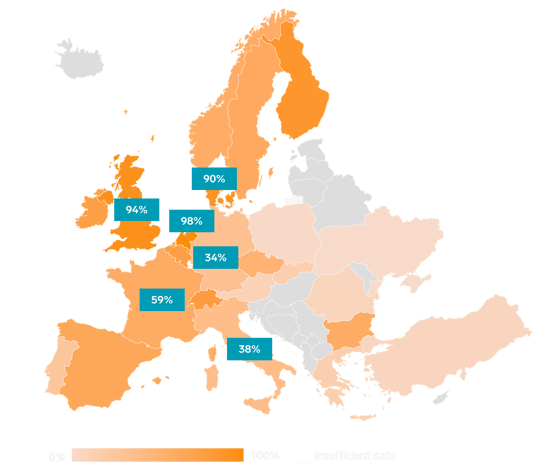
Across Europe, cloud print adoption averages 63.2%, with a clear split between Northern and Western Europe and the rest of the region.

  • Northern and Western Europe are cloud-first, with cloud shares mostly exceeding 90%. Current fast movers include the UK at 94%, the Netherlands at 98%, and Denmark with a 90% cloud share. 

  • Major economies in Central Europe show strong absolute cloud growth but still have meaningful on-premise bases, with France reaching a 59% cloud share, Italy at 38%, and Germany at 34%.

  • Central and Eastern Europe remain earlier in the transition, with cloud shares still in single digits in many markets. However, these regions are beginning to move as infrastructure and technology constraints gradually ease.

Look ahead side cloud

US & Canada

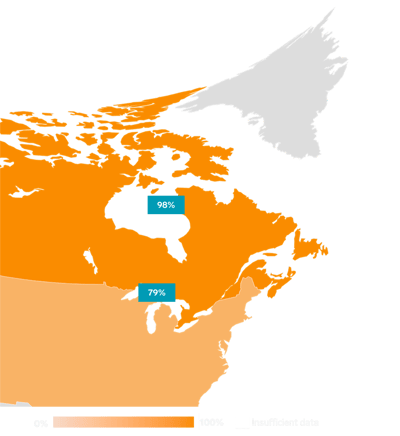
Cloud adoption in the US and Canada was already high in 2024, reaching 73% a year ahead of the global tipping point.

This region is considered one of the most mature SaaS and cloud markets globally, with strong growth expected in the next few years. Today, 79% of projects across Canada and the US are cloud-first, and much of this demand comes from tech-savvy enterprises adopting cloud print at scale. While these percentages trail some Western European markets, the US, in particular, has the highest billings value in absolute terms. As a result, even small percentage shifts translate into substantial cloud volumes in this region.

Asia Pacific

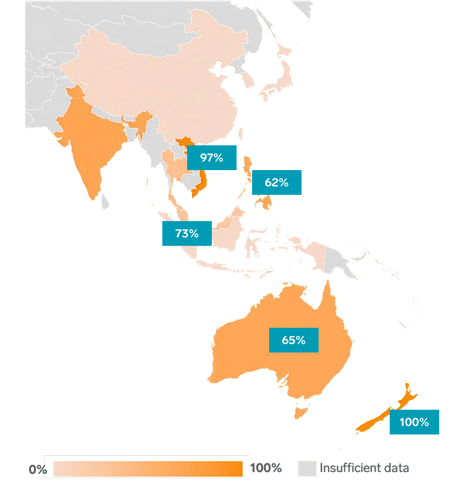
Adoption varies across APAC by market maturity, but overall 66.6% of projects are cloud-first.

  • Australia and New Zealand continue to set the standard for cloud maturity, reflecting established SaaS practices and strong connectivity.

  • Asia’s cloud landscape is accelerating, and future growth will largely depend on policy and partner readiness. Mature hubs like Singapore lead with cloud-first strategies, while emerging markets, including Malaysia, Hong Kong, and Thailand, are primed for accelerated cloud adoption. The Philippines shows steady progress through hosted adoption, and China remains a strategic growth target pending regulatory alignment.

  • Japan represents a structural exception within the region as billing is centralized through parent entities, so is excluded from regional adoption comparisons.

  • In India, new opportunities are increasingly cloud-based, though adoption remains slower than in other markets due to more complex sales cycles, with greater activity expected from 2026.

Rest of the World

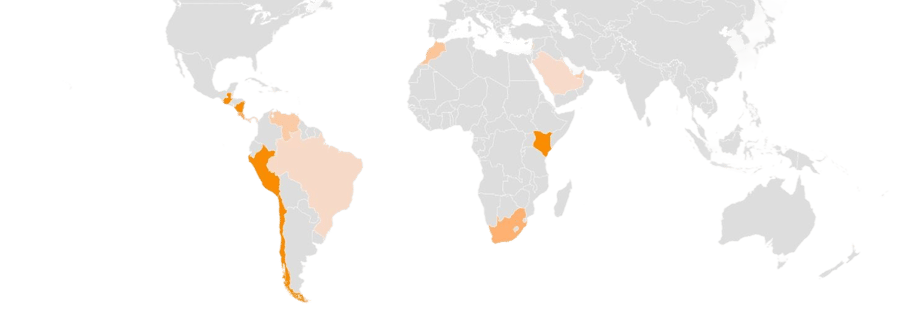
  • Latin America: Subscription services are widely used in LATAM, and cloud adoption has reached a tipping point with growing interest in Y Soft’s Cloud Transition License program. This is despite facing challenges around infrastructure, internet reliability, and labor costs. Today, 47.7% of projects here are cloud-first, coming out of countries like Peru, Chile, Costa Rica, and Panama.

  • Middle East and Africa: MEA is in the early stages of cloud adoption, focusing on foundational readiness at the country level. While the overall cloud share is 28.9%, momentum is building—Saudi Arabia drives growth through local data center mandates, South Africa leads as a regional benchmark at 53.5%, and opportunities are expanding across the UAE, Qatar, and Oman. Cloud adoption is growing in Africa, helping companies overcome infrastructure issues. In areas where native cloud isn’t feasible, hybrid setups serve as a practical alternative to bridge the gap and keep data local.

USAGE PATTERNS: PRINTING AND SCANNING 

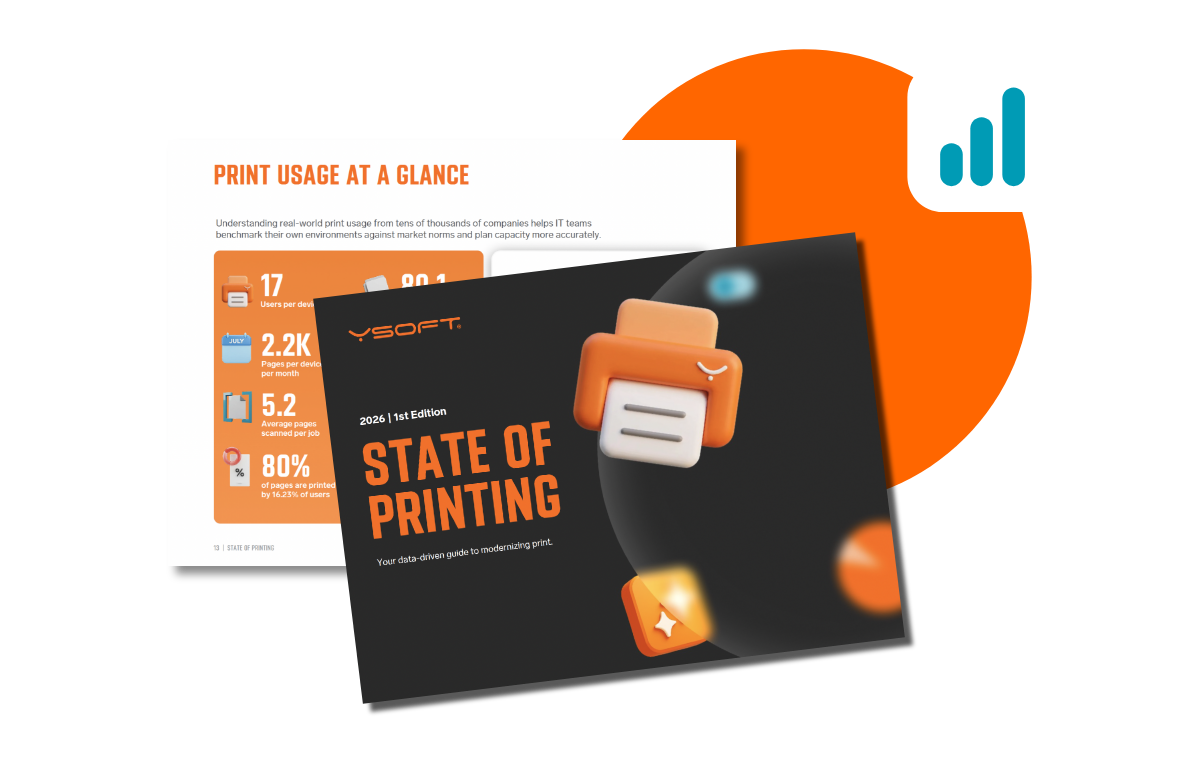
Understanding real-world print usage from tens of thousands of companies helps IT teams benchmark their own environments against market norms and plan capacity more accurately.

At a glance:

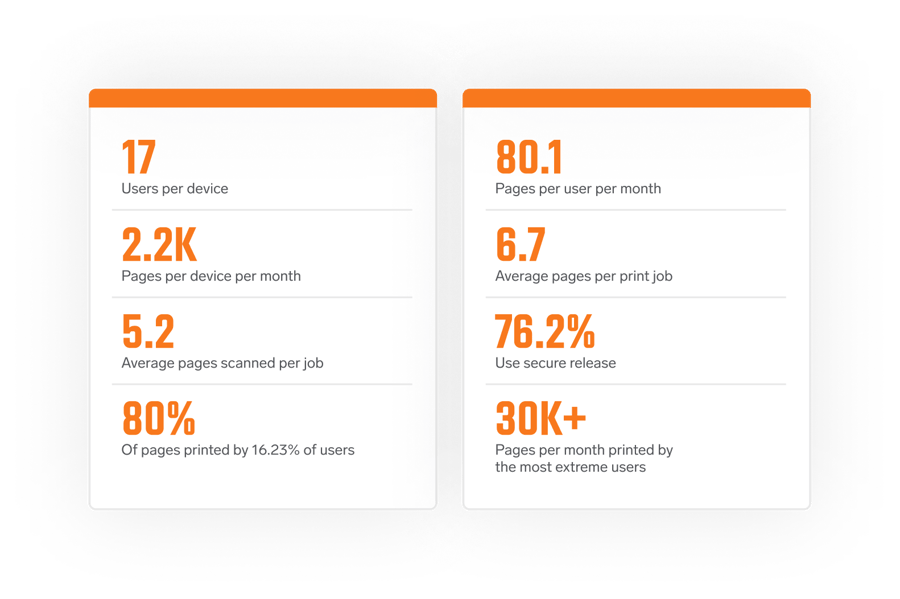
  • 17 users per device
  • 2.2K pages per device per month
  • The average number of pages scanned per job is 5.2
  • 80% of pages are printed by 16.23% of users
  • 80.1 pages per user per month
  • 6.7 average pages per print job
  • 76.2% use secure release
  • 30K+ pages per month printed by the most extreme user

PRINT REMAINS CORE, INSIGHT FALLS SHORT

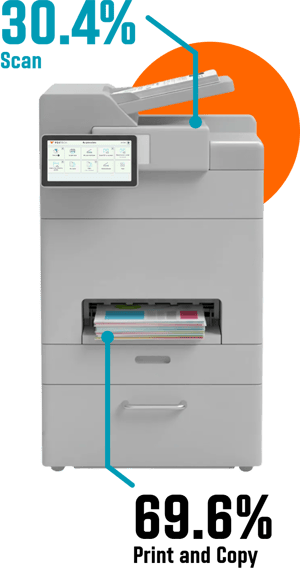
If we look at how devices connected to the SAFEQ Cloud platform are used, we see 69.6% of device activity attributed to printing and copying, and the remaining 30.4% to scanning across cloud and device-native workflows. Many IT teams lack detailed data on how print services are being used, where inefficiencies exist, or how usage patterns change over time. This makes it difficult to manage costs, capacity, and user behavior effectively.

68% don’t have detailed insight into print and scan behaviors

Scan Volumes Reveal Untapped Automation Potential

While scan volumes are high, much of this activity still relies on basic workflows. Many automation features, such as automated document separation, page type recognition, and document routing, are available but remain lightly used.

In many cases, a single button press could move documents faster through the business. This gap highlights a clear automation potential and reinforces why Y Soft will continue investing in scan workflows and advanced device capabilities as part of the SAFEQ Cloud roadmap.

Telemetry data in SAFEQ Cloud reveals:

  • 40 million pages scanned per month
  • 1.9 million scan jobs sent to users' email
Mail

Scan to email

1.9 million jobs/month

ysoft icon_circle_positive_Scan Document Capture

OCR Text Search

616 thousand jobs/month

SAFEQ Cloud icon

Scan to Cloud Storage

125 thousand jobs/month

Flexibility

Document Separation

120 thousand jobs/month

ysoft icon_circle_positive_Plugin

Scan to Extension

36 thousand jobs/month

Security Scan

Barcode Recognition

14 thousand jobs/month

FOR SOME COMPANIES, PRINTING NEVER STOPS

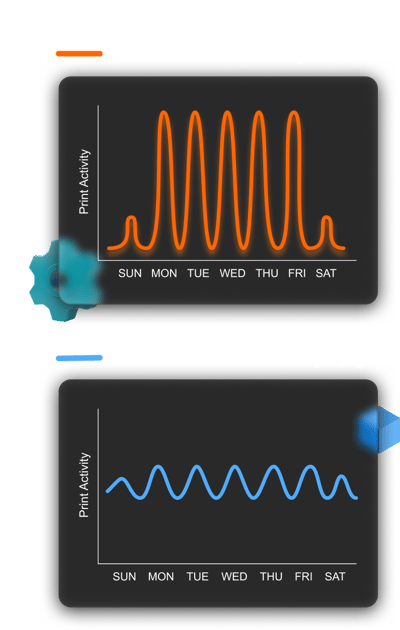
24/7 print and scan round the clock.

Time-of-day usage patterns across data centers follow expected business-hours behavior, the standard 9–5 workday.

What surprised us was that, for some customers, we see round-the-clock printing and operations that never sleep. In manufacturing environments, for instance, we see 24/7 operations, in contrast to typical office usage patterns.

Printing isn't just important for this customer’s business; it's mission-critical to their factories and production. Their decision to run on reserved infrastructure (a single-tenant environment) underscores print's importance to their operations and their preference for a managed environment that doesn’t require them to spend IT resources.

To support organizations where printing is mission-critical, Y Soft offers options such as reserved infrastructure and 24/7 support.

Secure Print Rules Reduce Paper Waste in the Millions

The majority of customers use secure release to keep information confidential and minimize the risk of documents being left in the output tray. By applying print rules and security policies, companies that use cloud print solutions can reduce waste and save costs.

Across a sample size of 1M+ users, we see an average reduction of 13% in needlessly printed pages through secure release. Actual results vary by organization, but this gives a clear baseline drawn from real usage data—rather than sales pitch estimations.

13% of submitted print jobs are never released: That's 130M+ pages per year never printed.

“Data from SAFEQ Cloud customer environments shows that a significant share of print jobs are never released, reducing paper, toner, energy use, and print-related costs. For many customers, the avoided printing cost alone can outweigh the cost of the solution.” - Hyder Mohammed, Managing Director APAC, Y Soft.


MODERNIZING THE PRINT STACK

PRINTING WITHOUT DRIVERS: THE INDUSTRY’S CLOUD FUTURE

No new third-party print drivers will be certified or distributed via Windows Update. This shift reflects what IT professionals have felt for years: device-specific drivers are a legacy approach in a world moving toward zero-trust.

Organizations are moving away from managing hundreds of print drivers toward cloud platforms where driver functionality is built in. SAFEQ Cloud supports this shift through Microsoft IPP Class Driver support for Windows Protected Print, including built-in finishing options on supported devices.

Although SAFEQ Cloud can support vendor drivers, most organizations rely on its cloud-native approach, delivered through the SAFEQ Cloud PC Client. Its effectiveness is proven at scale, with over one billion pages printed annually.

Ultimately, the industry is moving toward unified standards and cloud platforms where IT teams no longer need to manage print drivers. SAFEQ Cloud is built for where the industry is heading—simplifying IT, reducing reliance on legacy infrastructure, and helping organizations confidently move beyond traditional print management.

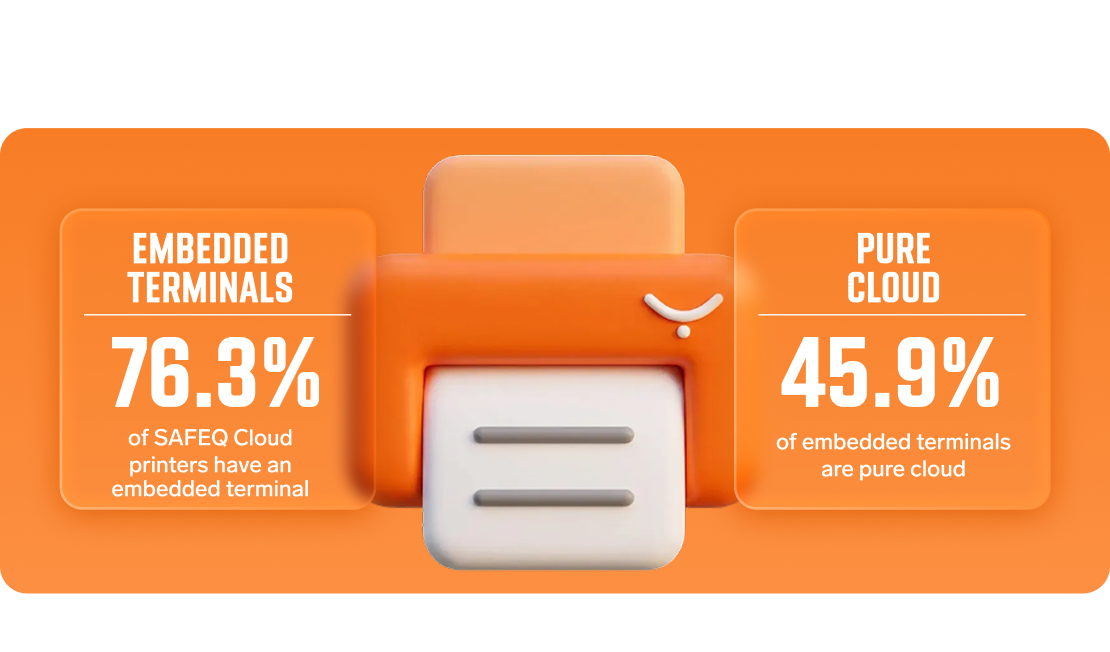
EMBEDDED CLIENTS BECOME THE BACKBONE OF SECURE PRINTING 

Embedded clients are central to secure document-handling workflows in shared device environments. They let users submit print jobs to a central queue and release them at the printer after authentication, while also providing access to secure scan workflows.

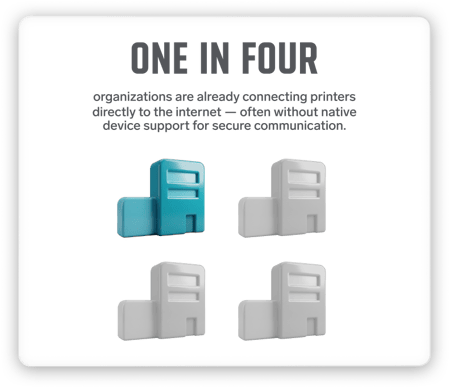
But legacy embedded terminals may not be inherently secure over the internet. Today, one in four organizations is connecting printers directly to the internet: Often without native device support for secure communication.

In zero-trust environments, many customers opt for pure cloud-embedded terminals as they transition from corporate networks to “internet-only” environments. That's because they ensure encrypted web communication, cloud-safe protocols, and centralized policy enforcement, keeping cloud-powered print environments protected.

A pure cloud embedded terminal is an MFP-resident application that:

  • Is deployed from the cloud

  • Authenticates users against a cloud identity

  • Communicates directly with cloud services

  • Requires no on-prem application server, print server, or gateway VM

Edge Gateways In a Cloud-First World


While cloud-enabled embedded terminals give users the most secure print setup, not every device in a customer fleet may support pure cloud communication. That’s where an edge device (or gateway) becomes essential.

A gateway serves as a local control point inside the network, enabling older or less advanced devices to share in cloud workflows without compromising security or functionality.

They support low-bandwidth offices to maintain functionality even when the internet is down. With automated gateway updates, IT teams don’t have to manage updates themselves.

Despite declining use of hybrid architecture features, gateways offer flexibility for those who need it, so they can modernize at their own pace while still benefiting from cloud-driven security, scalability, and centralized management.

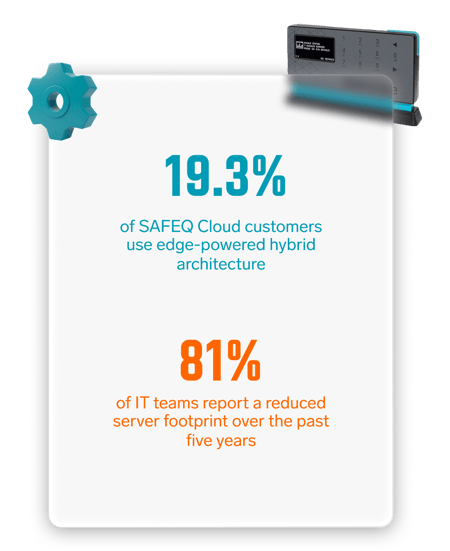
  • 19.3% of SAFEQ Cloud customers use edge-powered hybrid architecture
  • 81% of IT teams report a reduced server footprint over the past five years

SECURITY AND COMPLIANCE BY DESIGN

SECURE RELEASE ADOPTION SOARS ACROSS CLOUD PRINT FLEETS

To meet advanced zero-trust practices, print tools must provide safeguards such as secure release, starting with a consistent set of authentication options that prevent data from falling into the wrong hands.

SAFEQ Cloud supports a range of market-leading Identity and Access Management providers, although amongst our existing customers, Entra ID dominates. In cases where it’s needed, SAFEQ Cloud can run with multiple authentication providers to support separate user groups, allowing them to use a single print solution with a consistent authentication experience.

  • 69% of customers use Microsoft Entra ID for identity management
  • Only 15% IT teams follow Zero Trust principles for print and scan security

DYNAMIC CLOUD UPDATES PROTECT AGAINST EXPLOITABLE VULNERABILITIES

Within our on-prem customer base, data shows customers often delay software updates. For many IT teams, updating software that is working well in their day-to-day isn't a priority. This leaves their environment more susceptible to vulnerabilities. Cloud technology opens the door for auto-updating and rapid security patching. For SAFEQ Cloud, new updates are added every two weeks through an auto-update sequence that pushes to customer environments worldwide.  Security updates are even more frequent with zero downtime patches applied ad-hoc.

  • 84% of all on-prem installations have not been updated in over 12 months
  • 78% of IT teams do not consider printing and scanning a top 5 IT priority

COMPLIANCE AS A FOUNDATION FOR CLOUD ADOPTION

Compliance is a critical requirement for cloud print solutions. It ensures that the tools IT teams adopt meet process regulations, follow industry standards, and fit within company policies. That assurance enables companies to integrate and scale systems that house company data.

Y Soft takes compliance seriously, embedding it into both product design and operational practices. The Y Soft Trust Center serves as a central starting point, providing access to certifications and compliance documentation. SAFEQ Cloud ensures that all print, copy, and scan actions are logged within its zero-trust environment, making it easy for authorized IT personnel to review necessary data for their own compliance purposes.

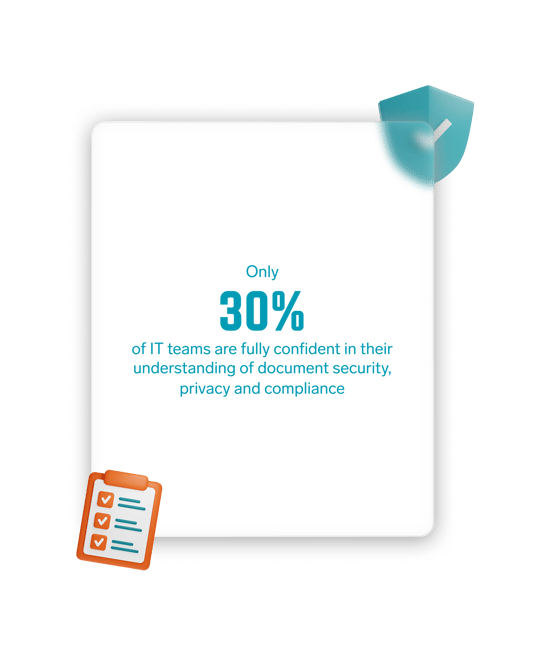
Only 30% of IT teams are fully confident in their understanding of document security, privacy, and compliance.

REGIONAL DATA CENTERS HAVE TURNED CLOUD PRINT INTO A COMPLIANCE ALLY

Alongside third-party security validation, sovereign data centers play a key role in compliance. They allow companies to keep data within specific jurisdictions or public-sector frameworks to meet local requirements. As a result, organizations increasingly require print solutions that support local data residency needs while still operating at global scale. SAFEQ Cloud meets this requirement through a network of data centers across nine locations.

To further support data sovereignty requirements, SAFEQ Cloud can be deployed so print jobs are stored and spooled locally within the customer’s environment. This can be achieved through hybrid components or directly at the user workstation, ensuring sensitive data remains within local networks and jurisdictions while still benefiting from centralized cloud management.

For each data center, users can rely on dual or triple redundant availability zones and security reinforcements for each zone to make sure their system remains up and running.

40%of customers believe that they understand data residency ‘very well’.

AVAILABILITY BEYOND UPTIME

A  24-hour print outage is more than an inconvenience for most organizations.

  • 75% of IT teams expect moderate or major disruption

  • 17% say business workflows would stop

For years, Service Level Agreements (SLAs) in print have focused on a single metric: uptime. Server availability was seen as a proxy for reliability, resilience, and user experience. But as print stacks become cloud-connected and business-critical, uptime alone is no longer enough. Customers need more than working servers—they need uninterrupted printing, scanning, and updates. Availability must reflect outcomes, not just infrastructure: a platform may be operational, but if users can't print or route documents, that’s unacceptable for critical services.

One sign of SLA maturity is public visibility, including real-time status and historical data, accessible without a login. Automated alerts for incidents and maintenance are equally vital; silence during an outage can be more damaging than the outage itself. Ultimately, the presence—or absence—of a public status page speaks volumes.

“Modern SLAs should answer real questions: Are print jobs leaving devices? Are scans reaching destinations? Are updates deployed without downtime? Can issues be flagged before users notice? Without transparency, customers rely on assumptions—a poor foundation for reliability.” - Martin de Martini, CIO, Y Soft.


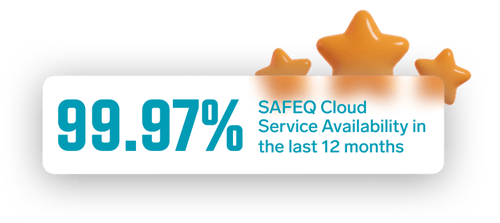
In 2025, Y Soft reached a 99.97% SAFEQ Cloud Service Availability.